


















































Hindi films and their dubbed versions made up 44% of 2026 total
Indian cinema has just rewritten its own record books, and there are still weeks of the 2026 calendar left to run.
The Week reports that Indian theatres collected Rs 13,775 crore (about £1.1 billion) up to 15 November, already above the Rs 13,350 crore (about £1.07 billion) that made 2025 the previous best, with 46 days still to play.
Sacnilk’s figures tell the same story globally, putting worldwide earnings at Rs 15,639 crore (about £1.25 billion) by 16 November from 1,141 Indian films.
The two totals measure different things, since one covers ticket sales inside India and the other counts worldwide gross for Indian titles, so they should not be compared directly.
Indian cinema has crossed Rs 15,000 crore (about £1.2 billion) for the first time, after the pandemic lockdowns left cinemas with two of their worst years in 2020 and 2021.
The climb has been gradual, with totals of roughly Rs 11,500 crore (about £920 million) for 2023 and Rs 11,835 crore (about £950 million) for 2024.
The Dhurandhar effect

No single film shaped the year more than Dhurandhar: The Revenge, the Ranveer Singh spy thriller that opened worldwide on 19 March.
It is the sequel to 2025’s Dhurandhar, which was the highest-grossing Hindi release of that year.
Its opening day brought Rs 145.55 crore net (about £11.6 million), including more than Rs 40 crore (about £3.2 million) from paid previews, making it Bollywood’s biggest opener ever.
It was also the first Bollywood release to earn Rs 200 crore gross (about £16 million) in a single day, against the roughly Rs 130 crore (about £10.4 million) that Jawan had managed.
The film became the fastest Indian title to enter the Rs 1,000 crore club (about £80 million), reaching Rs 1,088 crore worldwide in its first week.
It is now the biggest earner of 2026 with Rs 1,375 crore (about £110 million) in domestic collections.
Ramayana joins the chase

The second pillar of the record is Ramayana: Part One, which arrived around Diwali and lifted collections to a new high.
It had reached Rs 935.38 crore (about £75 million) by 15 November, second only to Dhurandhar 2 among this year’s releases.
Together, the two films have earned over Rs 3,000 crore (about £240 million), which is more than 20% of the year’s total gross.
Put another way, roughly one rupee in every five earned by Indian cinema this year came from just two Hindi epics.
In India, Ramayana crossed Rs 100 crore (about £8 million) net in just two days, matching the pace of Animal.
It also became the first Bollywood film to pass Rs 50 crore gross (about £4 million) in Kerala, doing so in only 13 days.
Ramayana entered the top five highest-grossing Indian films in just 12 days, with an estimated gap of about Ra 305 crore (about £24 million) to Pushpa 2.
That means its remaining run, including its overseas business, will matter for the final yearly total.
The dominance of a single event film is easy to see in the daily collection data. On 15 November, tracking showed Ramayana at Rs 70.20 crore (about £5.6 million) for its eleventh day, while the next-best title collected just Rs 0.33 crore (about £26,000).
Ramayana’s historic UK debut
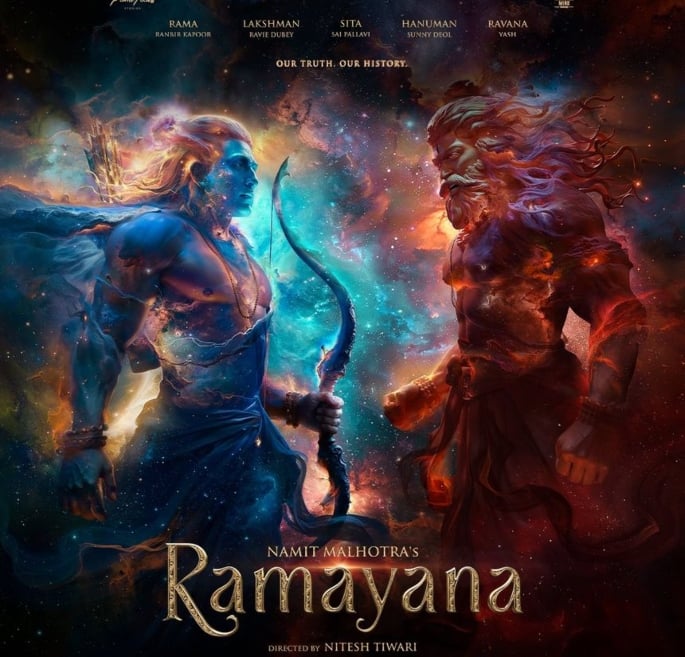
Ramayana’s British debut was historic. Hollywood Reporter India says it became the first Indian film to top the UK and Ireland weekend box office, earning a record £1.7 million for an Indian film from 6 to 8 November across 364 cinemas.
Four earlier Indian hits had stopped at second place, so the top spot had never before carried an Indian film’s name.
Other trackers put the extended opening weekend at £2.1 million to £2.15 million, which probably explains why totals differ, since the figures cover different periods.
The weekend chart was tight, with only about £300,000 separating the top three films.
That makes the win more notable, because Ramayana beat two big studio and franchise releases on the same weekend.
Opening day alone brought £440,000, a record for a Bollywood film in the UK, beating the £427,000 set by Dhurandhar: The Revenge.
Dubbed versions also contributed to that figure, so audiences watching in other languages are part of the picture.
The film ranked second worldwide for the weekend ending 8 November, with a $52.15 million opening, and is reportedly mounted on a Rs 4,000 crore (about £320 million) budget across its two parts.
With that much riding on it, the film needs to keep travelling well in markets like Britain.
Why this matters for British Asians

The 2021 Census recorded 1.86 million people of Indian ethnicity in England and Wales, or 3.1% of the population, alongside 1.59 million Pakistani and about 645,000 Bangladeshi residents, within a wider Asian population of 5.5 million, or 9.3%.
That is a large home audience, and Ramayana’s chart-topping weekend shows what happens when families turn out together.
For many British Hindu families, the Ramayana is a story known from childhood, which helps explain why a film about it could draw crowds on this scale.
The same census counted about 1.03 million Hindus in England and Wales, or 1.7% of the population.
Territory data shows $2.875 million from the UK out of $23.375 million overseas for the extended opening weekend.
That means Britain supplied about an eighth of Ramayana’s overseas opening, which shows how much weight British Asian audiences carry for distributors.
It wasn’t only Bollywood

Bollywood did not do it alone.
Hindi films and their dubbed versions made up 44% of the 2026 total, followed by Telugu at 18% and Tamil at 15%, with English-language releases at 9%, Malayalam at 7%, Kannada at 3% and other languages at 4%.
Rajinikanth’s Jailer 2 shows the southern pull, with a gross of Rs 835 crore (about £67 million).
Inside Indian theatres, Hollywood’s Spider-Man: Brand New Day made Rs 599.25 crore (about £48 million), Jailer 2 made Rs 555.25 crore (about £44 million) and Drishyam 3 made Rs 455.75 crore (about £36 million).
The year’s biggest surprise may be Hanuman Ansh, made for only Rs 2 crore (about £160,000) and now earning more than Rs 440 crore (about £35 million). Mirzapur: The Movie, a big-screen spin-off of a web series, also grossed Rs 325 crore (about £26 million).
Foreign releases have added more than Rs 1,500 crore (about £120 million) to India’s box office this year.
That is one reason Avengers: Doomsday, set for 18 December, is expected to push the year-end numbers higher.
What comes next
The next big test is Shah Rukh Khan’s King, which the makers have confirmed for 24 December 2026, marking his return to the big screen after three years.
Yash Raj Films is listed as the UK and Ireland distributor, and Red Chillies and Marflix have partnered with the studio for the international release.
Anticipation is helped by history, since his last film with director Siddharth Anand, Pathaan, grossed Rs 1,050 crore (about £84 million).
The film also marks Suhana Khan’s big-screen debut, which adds a family-story angle likely to travel well on social media.
King is reportedly aiming for a Rs 40-45 crore net opening (about £3.2-3.6 million), which would beat Dhoom 3’s Rs 36 crore (about £2.9 million) Christmas record for Bollywood. It arrives just days after Avengers: Doomsday and Dune: Part Three, which are both scheduled for 18 December.
December also brings Prabhas’ Fauzi on 3 December and Ajay Devgn’s Ranger on 4 December, so Indian cinema will be hard to miss. UK release dates for individual titles can differ from India’s, so readers should check local cinema listings before booking.
For British Asians, the lesson of 2026 is that family-sized stories and star power can still fill cinemas.
If Ramayana’s UK opening and King’s Christmas release are anything to go by, the next few weeks could write another chapter in that story.