

















































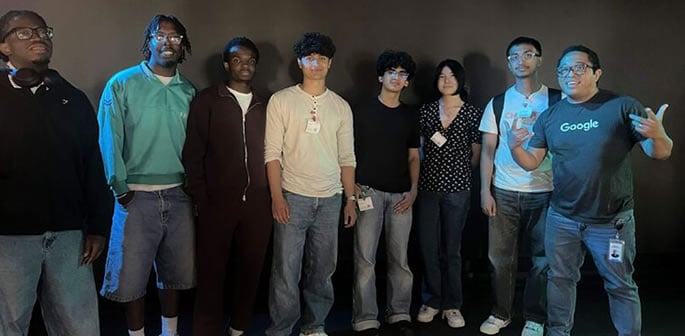
“Just attended the Google UK Student AI Hackathon"
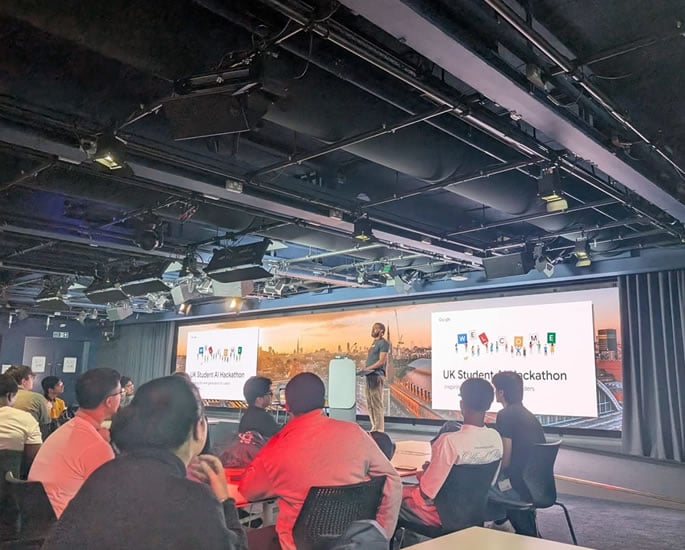
Google brought computer science and engineering students from UK universities together in London for a one-day AI hackathon focused on developing working applications using Google AI Studio.
The event took place on July 24, with selected students given four hours to develop prototypes before presenting their ideas to a panel of Google judges.
Harmehar Kaur, a computer science student at King’s College London, was part of a five-person team selected from hundreds of applicants.
She wrote on LinkedIn: “Out of nearly 1,000 applicants, our team of five was selected to build an AI solution using the Gemini API and present our working prototype directly to a panel of Google experts.”
University of Warwick computer science student Varshnay Sinha was among 52 students selected from more than 900 applicants.
He said: “Just attended the Google UK Student AI Hackathon, selected as 1 of 52 builders from 900+ applicants, and built MeetSpot in 4 hours!”
Eligibility was restricted to second and third-year undergraduate students studying computer science or a related subject at a UK university.
The event ran from 9 am to 6 pm and took participants through ideation, mentor feedback, prototype development, submission, presentations and judging.
Google engineers provided technical and product guidance, while projects were assessed on technical execution, product design, innovation, teamwork and potential business impact.
Kaur worked with Aarian Malhotra, Zidane Imran, Daniel Chigbu and Quvonchbek Rahmonov to develop RoomQuest.
The team began by considering whether gaming could encourage people to interact more with their surroundings.
Kaur continued: “In today’s disconnected world, how do we modernise gaming and encourage people to look up from their screens to interact with the physical world?”
Their answer was RoomQuest, an AI-powered game that transforms a physical room into a personalised escape-room experience.
Players upload photographs of their surroundings, allowing Gemini to identify objects and generate a story containing rhyming clues.
Players then photograph objects they believe answer each clue, with Gemini Vision checking their selections.
The team built the prototype using React, TypeScript, Node.js, Express, Vercel and the Gemini API, with Thierno Thiam providing mentorship.
Kaur added: “Designing, integrating, and deploying a functioning product within such a tight timeframe was an incredible lesson in fast-paced decision-making and collaboration.
“Beyond the project, hearing from Google employees and interns about their career journeys provided invaluable insight into the tech industry.”
Sinha used the four-hour development period to create MeetSpot, an application designed to help groups decide where to meet.
Rather than simply providing directions to a predetermined destination, the prototype considers the starting points of everyone in a group.
Users enter their starting locations and MeetSpot searches for places intended to provide fairer journey times.
The prototype can also account for dietary and accessibility requirements, budgets, atmosphere and weather conditions.
Sinha said: “MeetSpot does it in seconds.
“Everyone drops in their starting point and it finds real places with fair journey times for the whole group, with dietary and accessibility requirements, budgets and atmosphere already accounted for, and the conditions on the day factored in so nobody ends up on a terrace in the rain.”
MeetSpot can also use an uploaded Google Maps Timeline export to personalise its recommendations.
Sinha added: “You can also upload your Google Maps Timeline export so it learns the sorts of places you actually go, processed in your browser and never uploaded.
“Gemini is the reasoning engine, working over Places, Routes, Weather and Timeline data.”