
















































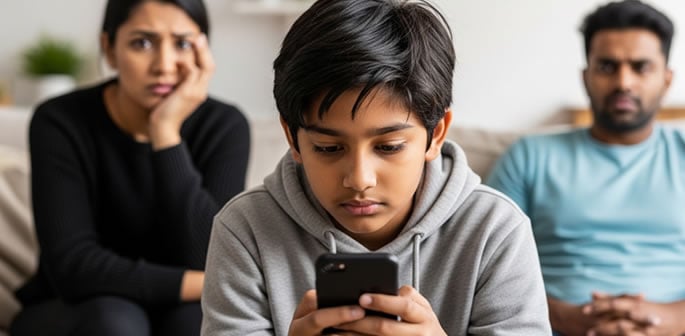
half had never discussed harmful online content with their child
Research has revealed that UK parents are unaware of what their children are seeing online.
As smartphones become a big part of childhood, that silence is now shaping how policymakers, charities and tech firms respond to online harm.
New research suggests the issue is not just exposure to harmful content, but a growing disconnect between children’s digital lives and adult understanding.
Government campaigns, safety guidance and renewed calls for regulation reflect a wider reckoning.
We look at what the data reveals, why conversation alone may not be enough, and how online safety is being redefined for a generation growing up inside algorithms.
Disconnect between Parents and Children Online

Polling by YouGov surveyed 1,030 parents of children aged eight to 14.
It found that half had never discussed harmful online content with their child. Around a quarter said they were unaware of what their child was seeing online.
The research was commissioned by the government as it consults on whether a social media ban for under-16s should be introduced.
The findings come as smartphone use becomes increasingly normalised in childhood. The government said the vast majority of 11-year-olds in the UK now own a smartphone.
For many families, online platforms are already part of everyday life before secondary school begins.
Separate research highlights how those experiences are changing.
A survey by the UK Safer Internet Centre and Nominet found that 60% of teenagers aged 13 to 17 are worried about AI being used to make inappropriate pictures of them.
More than one in 10 (12%) said they had already seen people their age using AI to create sexual pictures and videos of others.
Those concerns are not theoretical.
The UK’s information watchdog has launched an investigation into reports that Elon Musk’s AI chatbot, Grok, has been used to generate sexual imagery of children.
Campaigners argue that regulation has not kept pace with the speed at which generative AI tools are being adopted.
While public debate often focuses on screen time, the data points to a deeper issue.
Children are navigating algorithm-driven platforms with limited adult oversight. Parents, meanwhile, often lack the tools or confidence to begin conversations about content that is complex, disturbing or unfamiliar.
What is the Government Doing?

In response, ministers have launched the “You Won’t Know Until You Ask” campaign.
The initiative is designed to encourage parents to talk to their children about what they see online and to provide age-appropriate guidance on how to do so.
Yorkshire and the Midlands have been selected to pilot the campaign. It is being run by the Department of Science, Innovation and Technology and focuses on issues including body-shaming, rage bait and misogyny on social media.
The guidance has been developed with expert organisations including the NSPCC, Parent Zone and Internet Matters.
It will be available online and aims to support parents without dictating rigid rules.
Technology Secretary Liz Kendall said: “I know many parents are worried about what their children see and do online – often out of sight, and at times beyond their control.
“We are determined to give children the childhood they deserve and prepare them for the future.”
“That is why we are supporting parents with this campaign and launching a consultation on how young people can live and thrive in the age of social media.”
The guidance encourages parents to sit down with their children once a week and scroll through their favourite apps together to understand how algorithms shape what content is shown, shared and repeated.
Parents are advised to help children question what they see online. Suggested prompts include how a post makes them feel, who shared it and why it was posted.
The guidance urges scepticism around exaggerated language, emotional manipulation and attention-grabbing headlines.
It also focuses on helping children “take control of their feed”. Tips include following a wider range of accounts, using “Not interested” or “See less” settings and reporting content that is upsetting or harmful.
The System Needs Fixing

Alongside the government’s approach, online safety campaigners argue that parental guidance alone cannot address structural risks.
The Molly Rose Foundation has called for tech firms to be regulated like banks, with senior managers held accountable for product safety.
The charity was founded in memory of Molly Russell, who took her own life after viewing harmful content on social media.
Her father, Ian Russell, now chairs the foundation.
Speaking in parliament, he called for tougher action on platform design and regulation:
“We need a bold new reset of online safety laws that can decisively reverse years of quick fixes and put an end to addictive design and aggressive algorithms once and for all.”
Mr Russell said an Australian-style ban on social media for under-16s would give families a “false sense of safety”.
He urged the government to “fix and strengthen” the Online Safety Act and to act on the evidence already available.
The foundation is calling for new laws to “end harmful and addictive design, enforce risk-based age ratings and make safety and wellbeing ‘the price of admission’ for tech firms in the UK”.
It wants action across social media, gaming platforms, messaging apps and high-risk AI chatbots.
Concerns about online harm sit within a wider picture of children’s wellbeing.
Research from The Children’s Society shows that children are the most unhappy they have ever been. The Good Childhood Report measures well-being across family, friends, appearance, school and schoolwork.
The mean confidence score for children aged 10 to 15 fell to 7.43 out of ten in 2022 and 2023. That figure has declined steadily from 7.71 in 2019 and 2020. It peaked at 8.21 in 2010 and 2011.
Campaigners argue that online environments cannot be separated from those trends.
They say algorithmic pressure, exposure to harmful content and unrealistic online standards all shape how children see themselves and the world around them.
The evidence points to a simple but uncomfortable truth.
Children’s online worlds are evolving faster than the systems designed to protect them.
Government guidance may help parents ask better questions, but it cannot counter addictive design, opaque algorithms and the rapid spread of AI tools on its own.
Campaigners argue that without tougher regulation, responsibility will continue to fall on families least equipped to manage it alone.
As debates over bans and controls continue, the real test will be whether online safety becomes a baseline expectation rather than an afterthought.
For parents, platforms and policymakers alike, not asking is no longer an option.