
















































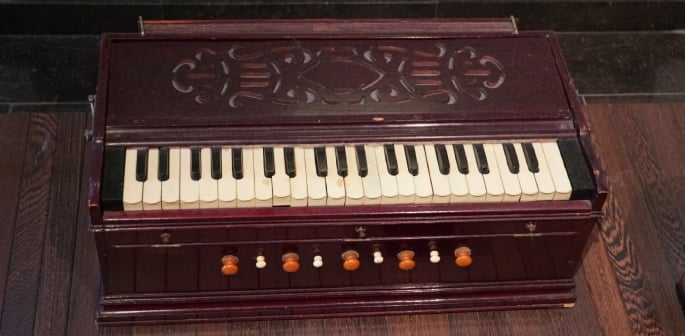
The harmonium has been embraced by countless musicians.
In South Asia, the Indian harmonium is one of the most popular instruments for creating melody and timeless tunes.
South Asia encompasses Pakistan, India, Bangladesh, and Sri Lanka, with the harmonium being a common asset to compositions and concerts.
The instrument has a rich history that is as mellifluous as the sound that it emanates.
Spanning decades of culture, the Indian harmonium has carved a unique place in the musical passages of the country.
DESIblitz explores the history and origins of this instrument. So sit back and relax as we tell you all about this melodious jewel.
Origins
 The harmonium has a fascinating history that began in Europe during the early 18th century.
Originally developed as a small pump organ, it was refined by French inventor Alexandre Debain in 1842.
The instrument functioned through the use of bellows and reeds, producing sound similar to that of a pipe organ.
Its compact size and portability made it an attractive option for musicians across different cultures.
During the 19th century, European missionaries and traders brought the harmonium to India.
Initially, it was used in Western-style church music, but Indian musicians quickly recognised its potential for local musical traditions.
The harmonium’s ability to sustain notes made it a valuable accompaniment for Indian vocal performances.
Over time, the instrument underwent significant modifications to better suit Indian music, including the removal of foot pedals and the introduction of hand-pumped bellows.
These changes allowed musicians to play while sitting on the floor, aligning with traditional Indian performance practices.
Evolution In India
 By the late 19th century, the harmonium had become an integral part of Indian music.
Classical musicians, particularly those in the Hindustani tradition, adopted the instrument for vocal accompaniment.
Unlike stringed instruments that required continuous tuning adjustments, the harmonium provided a stable pitch, making it a reliable partner for singers.
During the early 20th century, the harmonium’s popularity extended beyond classical settings.
It became widely used in folk and theatre performances, further cementing its role in Indian music.
However, despite its growing acceptance, the harmonium faced criticism from some quarters.
Some scholars and musicians argued that it could not produce meend – the smooth gliding transitions between notes that are a hallmark of Indian classical music.
This criticism led to its temporary exclusion from some classical performances.
In the mid-20th century, a significant shift occurred when radio stations imposed restrictions on the use of the Indian harmonium.
To preserve the authenticity of traditional Indian music, All India Radio banned its use in official classical broadcasts for several decades.
This decision led to a temporary decline in its presence within elite classical circles. Despite this setback, the instrument remained immensely popular at the grassroots level. B
By the 1970s, the ban was lifted, and the harmonium regained its place as a central instrument in Indian music.
Modifications to the Instrument
 Over time, the harmonium underwent several modifications to cater to the needs of Indian musicians.
The original foot-operated bellows were replaced with a hand-pumped mechanism, allowing players to maintain a comfortable seated position.
Indian harmoniums were also designed with multiple sets of reeds to produce a richer, fuller sound.
Some versions incorporated a scale changer, which enabled musicians to shift the pitch without manually adjusting tuning.
These modifications made the instrument more versatile and suitable for a wide range of musical styles, from classical to contemporary compositions.
The harmonium has been embraced by countless musicians who have contributed to its enduring legacy.
It has played a crucial role in shaping various forms of music, from classical to contemporary styles.
While originally used mainly for accompaniment, some artists have experimented with solo performances on the harmonium, showcasing its versatility and expressive potential.
Many celebrated musicians have recognised the harmonium’s unique qualities and have utilised it in their work.
In classical music, it has been a preferred accompaniment for vocalists, allowing them to maintain pitch and rhythm with ease.
In the world of film and popular music, the harmonium has also left an indelible mark, adding richness to compositions.
The instrument’s ability to produce sustained tones makes it an excellent choice for emotive and melodic pieces.
Use in Bollywood Music
 The harmonium has had a significant impact on Bollywood music, particularly during the golden era of Indian cinema.
Many renowned music directors incorporated the instrument into their compositions, creating timeless melodies that continue to be appreciated.
The harmonium’s warm, resonant tones were widely used in playback singing sessions, serving as a guide for vocalists to maintain pitch and flow.
Iconic songs from the 1950s to the 1970s frequently featured the harmonium, solidifying its place in the Indian film industry.
During live concerts, legendary singers, including Mukesh and Mohammad Rafi, were observed to play the harmonium while performing.
Even in contemporary Bollywood music, the harmonium remains relevant. While electronic instruments have become more common, many composers still use the harmonium to create an authentic and nostalgic sound.
The instrument is often present in recording studios, where it serves as a fundamental tool for composing melodies and guiding singers during playback sessions.
Modern Relevance
 The harmonium holds a prominent place in India’s diverse musical landscape.
It is widely used across different genres, from classical and semi-classical music to film compositions and experimental projects.
Despite early criticisms about its limitations in producing certain microtonal nuances, musicians have found innovative ways to enhance its capabilities.
Some artists modify the reeds and tuning mechanisms to achieve a more expressive sound, bridging the gap between traditional expectations and modern demands.
The harmonium’s accessibility has also contributed to its enduring popularity. It allows beginners to produce pleasant melodies with minimal instruction.
This has made it a favoured choice for both amateur musicians and professionals alike.
As musical styles evolve, the harmonium’s adaptability ensures that it will continue to be an important instrument for generations.
The journey of the harmonium from its European origins to its deep-rooted presence in Indian music is a testament to its remarkable adaptability.
Overcoming challenges and evolving with changing times, it has secured its place as one of the most beloved instruments in Indian music.
Whether in classical settings, contemporary compositions, or live performances, the harmonium enchants musicians and audiences alike.
Its rich history and enduring appeal highlight its importance in shaping India’s vibrant musical tradition, ensuring that it remains a cherished instrument for years to come.